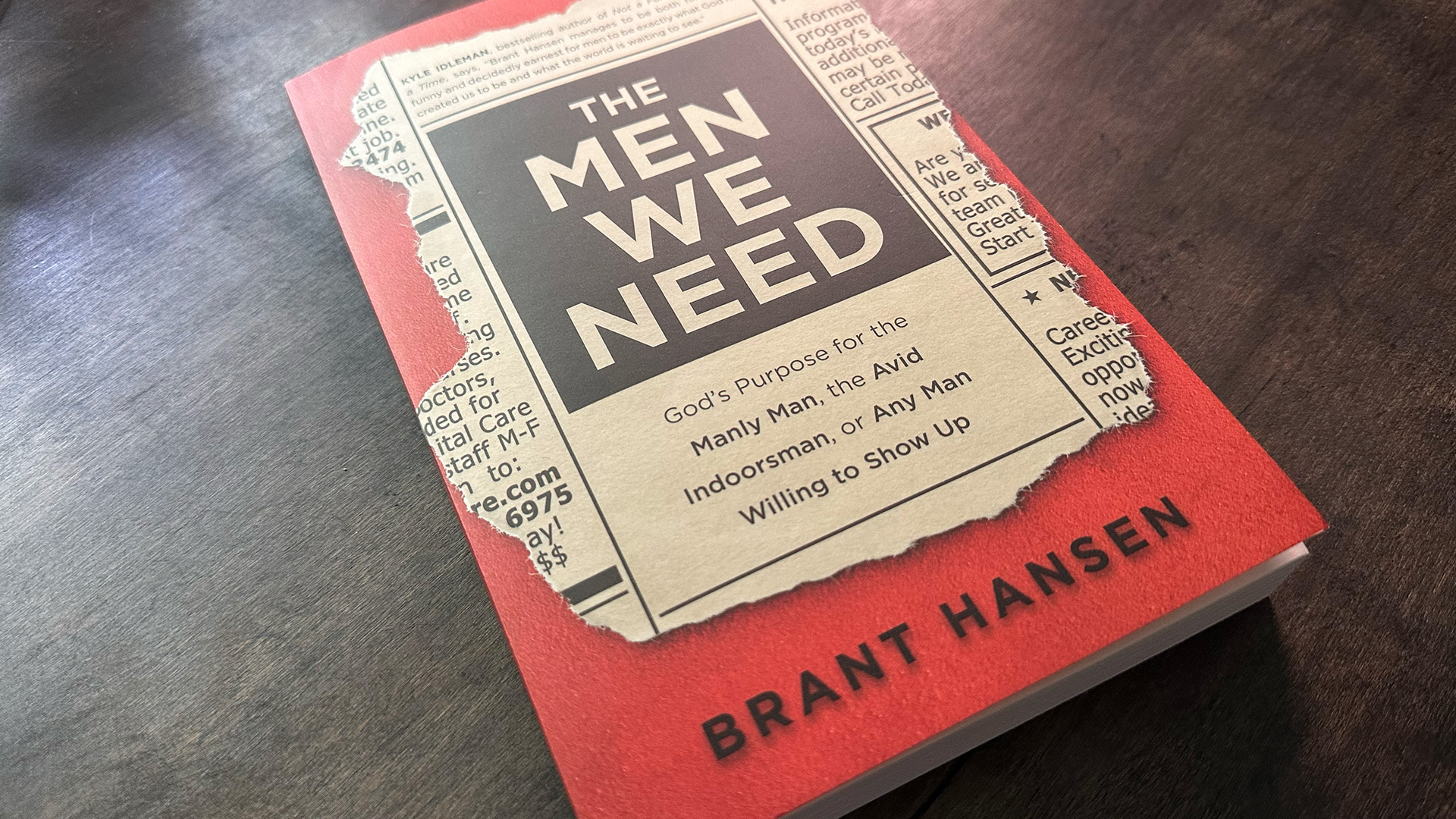
I knew pretty quickly that I was going to enjoy Brant Hansen’s The Men We Need. Not just because of the subtitle, God’s Purpose for the Manly Man, the Avid Indoorsman, or Any Man Willing to Show Up, but his writing approach.
Hansen is funny, direct, and wonderfully uninterested in playing the part of the stereotypical manly man. He describes himself as an “avid indoorsman.” He plays the accordion. He was diagnosed with autism as an adult. And somewhere in the opening pages, I thought, I know this guy.
My son is autistic, and some of Hansen’s observations, humor, and way of seeing the world felt familiar to me almost immediately. I began sharing parts of the book with my son as I read.

But somewhere along the way, the book started doing something else. It made me want to talk with other men. The Men We Need is about biblical manhood, but Hansen wisely avoids trying to turn every Christian man into the same kind of man. You don’t have to hunt. You don’t have to own a truck. You don’t have to know how to rebuild an engine, grow a beard, chop firewood, smoke brisket, or survive three weeks in the wilderness with a pocketknife and a piece of string.
You can if you want. Apparently, you can also play the accordion.
Hansen’s concern is much deeper than the cultural accessories we attach to masculinity. He wants men to understand what God designed us to do.
His controlling picture comes from the Garden of Eden. God placed Adam in the garden to work it and keep it. Hansen develops that idea throughout the book. A man is called to become a keeper of the garden. Wherever God places him, he should cultivate what is good, protect what is vulnerable, take responsibility for what has been entrusted to him, and help the people around him flourish.
That garden might be a marriage. It might be a family. It might be a church, workplace, neighborhood, friendship, or ministry. The question is simple: Is this place better because this man is here? It cuts through a lot of the confusion surrounding manhood.
Our culture tends to bounce between caricatures. Masculinity becomes either something suspicious that needs to be restrained or something exaggerated that needs to be performed. Hansen avoids both. He doesn’t spend his time trying to make men tougher, louder, more aggressive, or more impressive. He calls men to become responsible. And responsibility requires us to show up.
That becomes especially important because Hansen identifies one of the great dangers facing men as passivity. Men can withdraw from responsibility while remaining physically present. We can retreat into entertainment, work, hobbies, pornography, video games, phones, sports, or just plain emotional disengagement. We can occupy a room without really showing up in it.
Adam did that first. While the serpent deceived Eve, Adam stood nearby and failed to act. His passivity had consequences far beyond himself. Hansen argues that the same principle continues today. When men abandon the spaces God has entrusted to them, something eventually fills the vacuum.
So the book calls men to make six decisions. Forsake the fake and relish the real. Protect the vulnerable. Be ambitious about the right things. Make women and children feel safe rather than threatened. Choose today who you will become tomorrow. Take responsibility for your own spiritual life. Each of those decisions sounds fairly simple. That may be what I enjoyed most about the book.
Hansen has a way of cutting through the politically correct junk and cultural confusion that often makes obvious things difficult to say. He speaks plainly about men and women, strength and gentleness, responsibility and passivity. Yet he does so without turning biblical masculinity into a personality type.
The man who protects his family may be physically strong. He may also be quiet, awkward, artistic, bookish, analytical, or unable to change his own oil.
The issue is character. Will he use whatever God has given him for the good of others? Will he protect instead of exploit? Will he serve instead of demand? Will he control his anger rather than make everyone around him live under its threat? Will he pursue things that matter instead of wasting himself on artificial accomplishments? Will he take responsibility for his relationship with God? Will he show up?
Those questions began following me around while I read.
By the time I reached the fifth decision, I realized I didn’t want to finish the book by myself. So I called a few men and asked them to read it with me. We started meeting for coffee on Wednesday mornings before work.
I wasn’t entirely sure what would come from it. We simply read some chapters and talked about them. But the conversations became unusually honest. The book gave us permission to talk about things men often experience but rarely put into words.
We talked about our struggles. We talked about our marriages and families. We talked about where we were passive and where we needed to take responsibility. We talked about things we were doing well and places where God was growing us.
And we laughed. A lot.
Then we prayed for each other.
Something happened during those Wednesday mornings that went beyond discussing a book. We bonded. We learned things about one another that probably would never have surfaced in ordinary conversation. We encouraged one another. We challenged one another. We grew.
Eventually, we finished the book, but kept meeting. That may be the strongest recommendation I can give the book. It helped create the kind of thing the book itself calls men toward. Men showing up. Men speaking honestly. Men taking responsibility for their spiritual lives. Men helping other men become faithful husbands, fathers, friends, and followers of Christ.
There are plenty of books about masculinity that spend their energy trying to define what a “real man” looks like. Hansen asks a better question: What does a faithful man do?
He shows up. He takes responsibility. He cultivates what God has entrusted to him. He protects people who need protecting. He directs his strength toward the good of others. He pays attention to the man he is becoming. And he takes ownership of his walk with God.
That kind of man may be an outdoorsman. He may be an avid indoorsman. He may even play the accordion. Either way, he can be a keeper of the garden.
And those are the men we need.
Here are some notable moments from the book:
- Don’t be friends with fools. Pick some non-fools.
- Jesus told us to seek his kingdom first. When we take our cues from him, it’s not just good news for us. It’s good news for everyone around us.
- There are real humans outside your window who will suffer because you aren’t who we need you to be.
- The real female mind adds to us, challenges us, complements us, confounds us, confronts us, and makes us grow up.
- Taking responsibility is the very essence of masculinity.
- We have to rise to the occasion and take on the risk of relationships.
- Commitment brings freedom. Discontentment makes you dependent.
- Stay silent when needed, but never passive. Actively decide to wield your words carefully. Wield them to always defend and never wound the vulnerable people around you.
- Sometimes you might “feel” God around, sometimes you won’t. But that’s never the point.
The above excerpts are sometimes paraphrased for reasons of brevity and creativity. Bookmarks are designed to peak your interest by highlighting certain quotations, not for purposes of CliffsNotes. It is my intent to compel you to read the books in their entirety.